

Picture a couple planning the next two years. He starts a Masters in February. She comes with him on his student visa, works while he studies, and they both build some Australian experience before deciding what comes next.
It is a normal plan. Tens of thousands of families have used it.
On Thursday it stopped working.
On 17 September 2026, which happens to be Citizenship Day, the Minister for Home Affairs Tony Burke delivered the National Press Club address that had been delayed since August. He built it around three questions. Who arrives. Who stays. Who leaves.
We read the full transcript rather than the coverage. That turned out to matter, because several widely reported details are wrong. The family restriction is not limited to students. No new migration target was announced. And the priority list does not include healthcare.
Here is what was actually said. The short version is that the ladder now only goes one way.
What changed, at a glance
| If you are | What changed |
|---|---|
| A student bringing a partner | Closed, unless Pacific, ASEAN or a course such as a PhD |
| A 485 graduate bringing a partner | Closed as well, and almost nobody reported this |
| A student choosing your next course | You can only move up the qualification scale |
| A student changing course at the same level | Still allowed, but now needs a new visa |
| On a 417 or 462 wanting year two or three | Ballot, and year three is tiny |
| Coming as a visitor and applying onshore | No further stay on future visitor visas |
| In construction, agriculture, fisheries, resources or teaching | Faster processing, and better points if you are in a trade |
| Already here with family | Nothing changes, you will not be separated |
Students and graduates can no longer bring family
This is the biggest change for our clients, and the part the coverage got wrong.
for international students, we will no longer be allowing the attaching of family members for international students or for graduate visas
Read that twice. Graduate visas are included. If you are planning a 485 and expecting your partner to come with you, that sentence is the one that affects you.
The exceptions are narrow. Students from Pacific nations, students from ASEAN nations, and certain courses, with PhD given as the example. Skilled visa holders keep family reunion, and he was open about why. Australia wants those workers, and a worker will not come without a partner.
Nobody already here gets separated. Families attached to a current visa keep that status until they leave or become eligible for a permanent visa. What stops is adding new ones.
His argument was about fairness rather than numbers. An Australian citizen whose partner lives overseas waits years for that partner to arrive. An international student brought a partner from day one. He put those two facts side by side and let them sit there.
Only one of the three student moves is closing
He split student visa changes into three situations. Most reporting merged them into one alarming paragraph. They are very different.
Extension. You fell ill, or your provider collapsed, and you need another 12 months to finish. Unchanged.
Transfer. After a year the course is not the right fit, and you move at the same level or within the same institution. Still allowed. It now needs a new visa application so the move can be tested. He said plainly this is not the behaviour he is targeting.
Progression. You finish, and you choose what comes next. This is where the new rule lands.
You can go up the qualification scale, but only up the qualification scale.
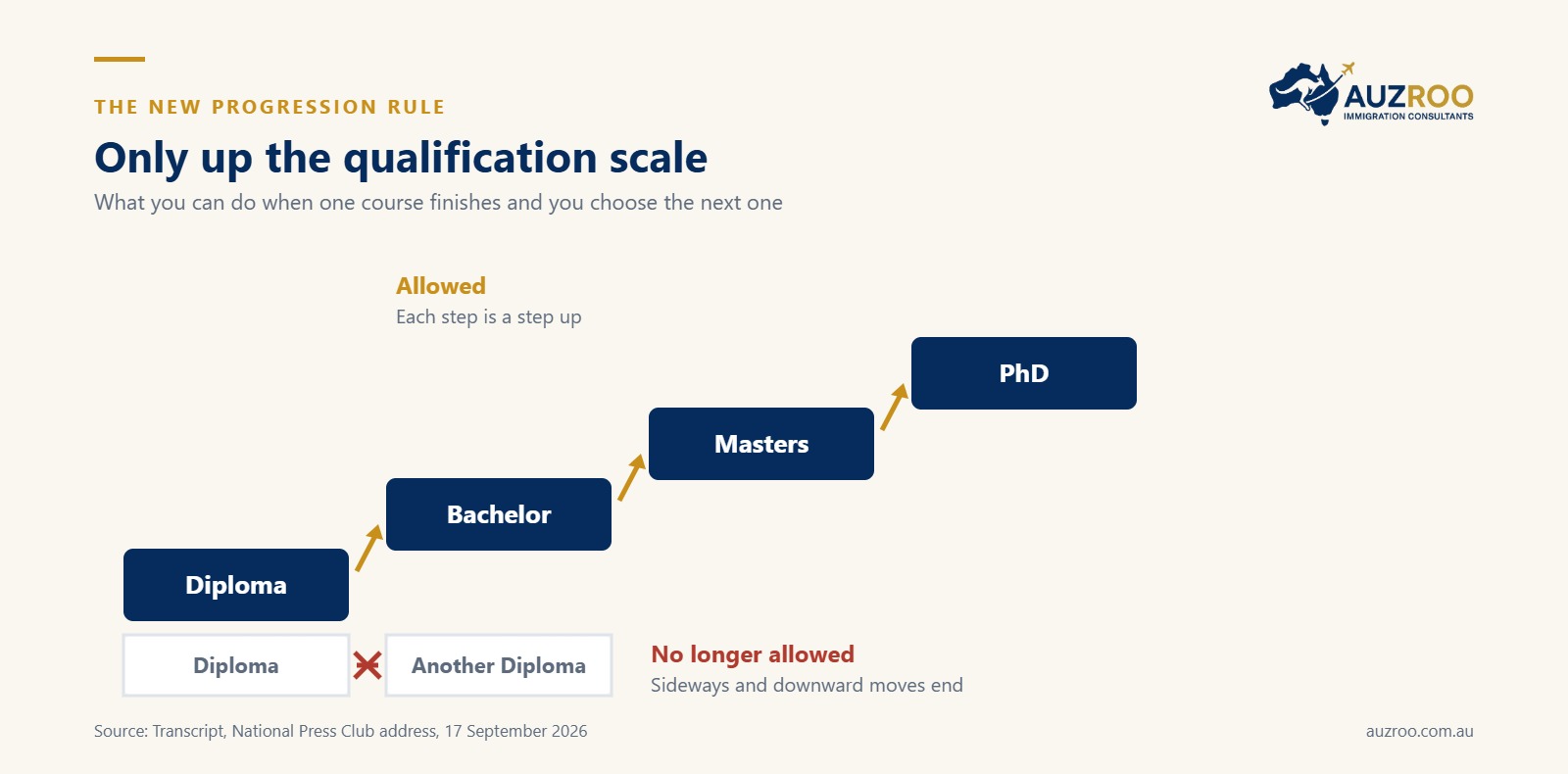
Bachelor to Masters, fine. Masters to PhD, fine. Diploma to another Diploma, no. Dropping to a cheaper provider at a lower level to keep a visa breathing is the exact pattern he described, and he described it in some detail.
If you have been using study as a holding pattern, the holding pattern is what is being removed.
The third year backpacker visa just became a lottery
The first year is untouched. Years two and three change completely.
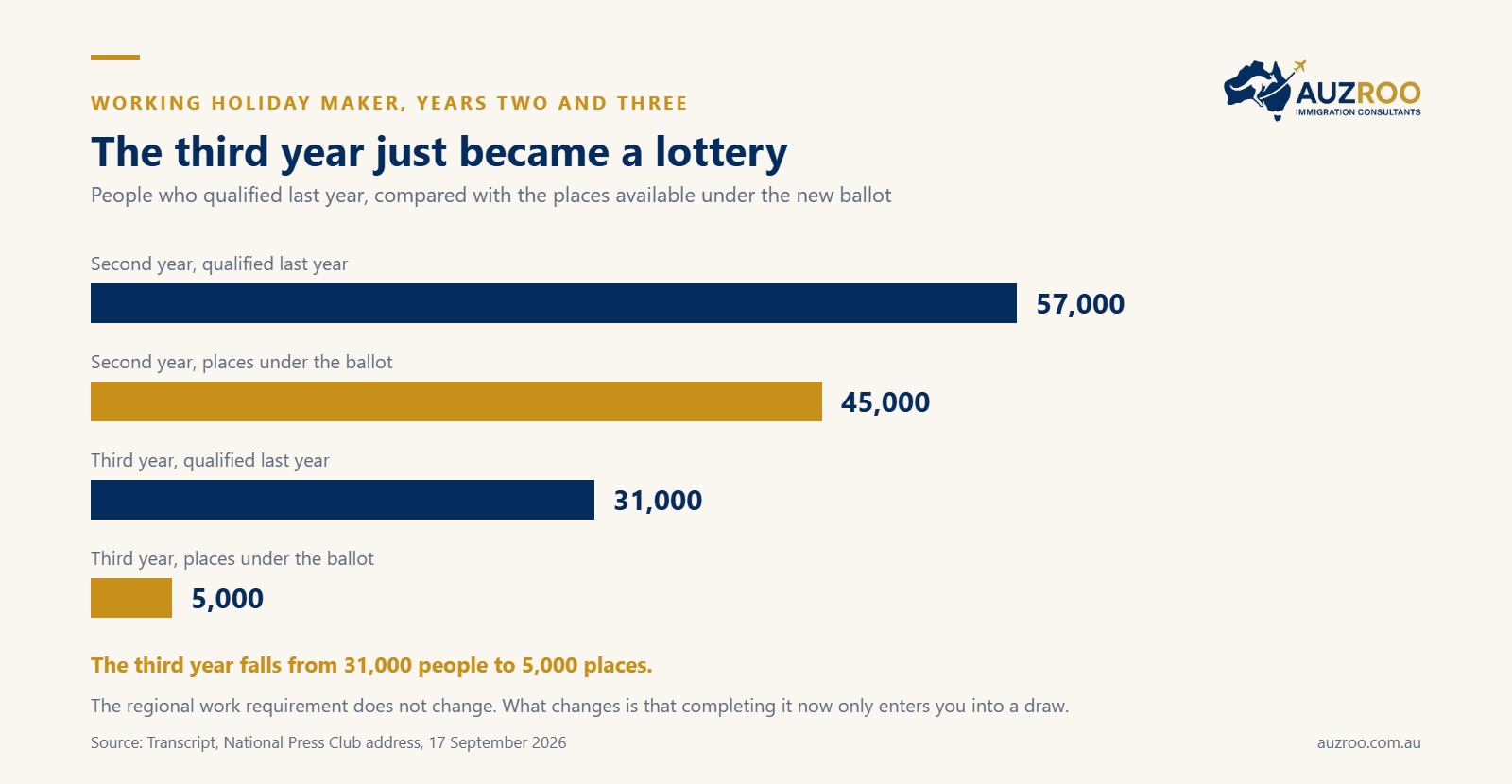
The second year goes to a ballot capped at 45,000 places, against 57,000 people who qualified last year. The 88 day regional work requirement does not change.
The third year is the one to sit with. From 31,000 people to 5,000 places, drawn by ballot, with the six month regional work requirement also unchanged.
What that work buys you has changed. Six months of regional work used to get you the visa. Now it gets you a ticket into a draw with roughly a one in six chance, if the same number of people apply.
He also explained why processing had slowed. UK backpacker numbers went from about 17,000 when the free trade agreement was signed, with a previous peak near 35,000, to just under 80,000 today. UK applicants have no regional work requirement under that agreement, so UK processing stays slow while the government keeps talking to London. Everyone else on the regional pathway gets normal processing speed back.
One number worth keeping. Backpackers alone added 48,000 to net overseas migration last year.
Visitor visas get “no further stay”, and it cuts both ways
Future visitor visas will generally carry a no further stay condition. Protection applications are the exception. Nothing changes for a visa already in a passport.
The obvious effect is that arriving as a visitor and switching onshore stops working.
The less obvious effect is the one he spent longer on. Because so many people have been using visitor visas as a side door, the department has been refusing genuine visitor applications that could not satisfy the temporary purpose test. Weddings. Funerals. A last visit to a dying relative. Every member of parliament has those cases. He expects more of them to be granted once the side door is shut, and he expects partners waiting on a spouse visa to be able to visit in the meantime.
Whether that happens in practice is worth watching. It is the one part of this package that could make life easier rather than harder.
Good news if you are in a trade
Two changes here, and one was reported incorrectly nearly everywhere.
The points test has been redone with Treasury. It gains a power that did not exist before, to lift particular skills so they score as though they were a higher qualification. On implementation, housing trades will earn the same points as a university qualification. That is a meaningful shift for anyone who has watched a degree outscore a trade certificate for years.
Ministerial Direction 119 is being split and expanded. The permanent and temporary programs currently run on nearly identical processing rules, which has meant a case stuck on the permanent side also gets stuck on the temporary side. The priority list is being extended to construction, agriculture, fisheries, resources and teaching.
Check that list again. A number of outlets reported healthcare. He said resources.
Migration agents can now be deregistered for this
This barely made the news and it deserved to lead.
The code of conduct for registered migration agents is changing. Agents who encourage clients to lodge protection claims with no merit will face consequences.
will be able to be sanctioned and will be able to be deregistered
He put a figure behind it. Applications from countries where more than 85 per cent of claims fail make up 80 per cent of the entire caseload.
The pattern he described is simple. A person reaches the end of their options. Someone advises them to lodge a claim they will lose. They then ride the appeals and the courts for up to nine years of work rights.
We welcome this, and we will say the quiet part out loud. If anyone has told you that a protection claim is a way to buy a few more years, that advice is about to become a deregistration matter for the person who gave it.
Overstayers, back to the pre 2015 model
Before 2015, an overstayer was given a bridging visa and told to leave. If they did not, they spent a short time in detention and usually booked their own flight within weeks. Others saw that and left on their own.
In 2015 mandatory visa cancellation changed who filled the detention centres, and the routine stopped.
The government is restoring the old approach. One hundred extra compliance officers. Two hundred and fifty extra beds. The former quarantine facility in Melbourne is being assessed for reuse.
He went out of his way to say this is not what people have seen on television in other countries. His words were no more and no less than what Australia did before 2015.
Why he says he had to do it
He did not announce a new migration target, which surprised the room. What he gave instead was context.
Net overseas migration figures released an hour before the speech put Australia 47 per cent below the post pandemic peak, and tracking slightly below the last budget forecasts. On his numbers, Australia will be about 700,000 people smaller by 2030 and 2031 than the pre pandemic projections had it.
Then he did the housing maths, and it is the most interesting part of the speech.
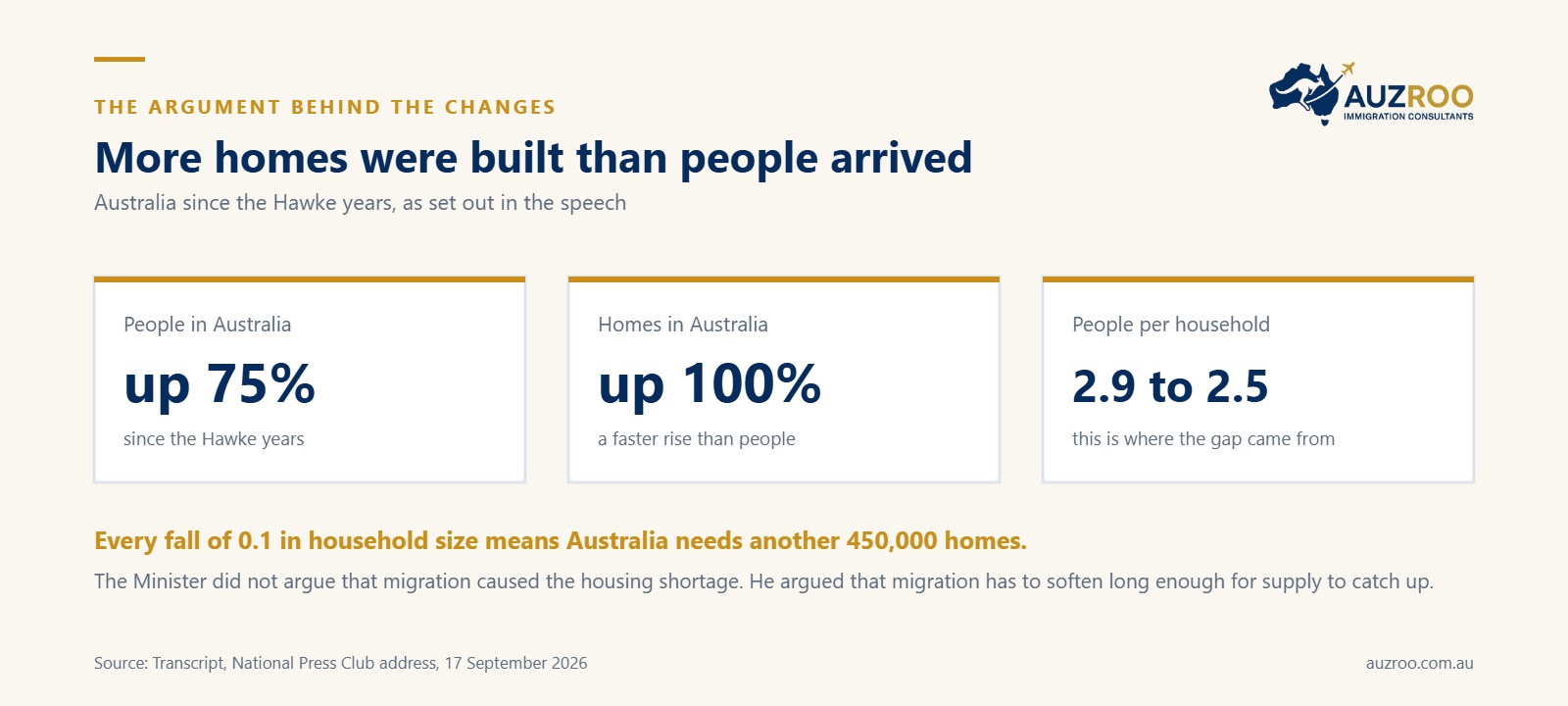
Since the Hawke years the number of people in Australia is up 75 per cent, and the number of homes is up 100 per cent. More homes were built than people arrived. The shortage came from households getting smaller, from 2.9 people to 2.5. Every fall of 0.1 in household size means Australia needs another 450,000 homes, and after the pandemic a lot of people decided they wanted more space.
So his conclusion was not that migration caused the housing crisis. It was that migration has to soften long enough for supply to catch up.
He also set himself a test worth remembering. Anything done to temper migration, he said, has to account for the economic cost, and that cost is not only in the regions. International education pays the wages of cleaners, maintenance staff and small businesses in every capital city.
Two smaller things he cleared up. The reforms were worked up and formalised by February this year, so they are not a reaction to the last few weeks of politics.
And then there is the claim that Australia imports yoga teachers instead of tradespeople. Construction workers brought in have tripled, from 4,500 to just under 15,000 last financial year. Yoga teachers brought in under this government: zero.
The part that was not about restrictions
It would be easy to read all of this as a country closing up. He opened the speech arguing the opposite, and it is worth repeating.
He rejected the phrase melting pot, because in a melting pot everything thrown in loses its shape. Australia, he said, is better understood as an orchestra. The point is not that every instrument sounds the same. It is that different instruments play together.
You can agree or disagree with the measures. That framing is still the one he chose to put first, on Citizenship Day.
What he wanted to do and could not
He said openly that the package is not as comprehensive as he would like, because two pieces need legislation he does not have.
- An expression of interest system, which would replace the demand driven model that has run major parts of the program since the Hawke and Howard years. This is the real structural change, and it is not happening yet.
- A faster way to resolve protection claims with no merit.
So there is more coming if the numbers move in Parliament. Plan for that, not against it.
What is still unknown
- No commencement date was given for any measure.
- The regulations and the new ministerial direction have not been registered, so the exact wording does not exist publicly yet.
- Transitional arrangements for people mid course have not been published.
- Nobody has defined the qualification scale or explained how AQF levels map onto it.
Do not read the missing dates as breathing room. Earlier this month a single instrument closed an entire course with about a month of notice, which we covered in One sentence closed the Graduate Diploma of Management (Learning). None of this needs to pass Parliament, so it can move quickly.
We will update this page as each instrument is registered.
What to do this month
Bringing a partner on a student or 485 visa. Lodge before the regulation is made, or plan for them to come on their own visa. Do not count on a grace period.
Choosing your next course. Make sure it is a step up, not sideways. A move that was routine last month may be refused next month.
On a 417 or 462. Do the regional work, but build a plan B. The third year is now a very small lottery.
Here as a visitor, thinking of applying onshore. Move now or expect the door to close.
In construction, agriculture, fisheries, resources or teaching. This speech was better news for you than for anyone else in the room. Check where you land on the new points test.
The honest summary
For years the system quietly tolerated a long temporary stay assembled from several visas in a row. Study, graduate work, more study, then something else. That is exactly what he described, and it is what he says is ending.
His own summary was three sentences.
If you want to come on a temporary basis to Australia, apply for a temporary visa. If you want to come to Australia permanently, apply for a permanent visa. And if you no longer have a valid visa, you should leave Australia.
Back to the couple at the start. His Masters still works. Her place in the plan does not. She now needs her own reason to be here, or they wait.
That is not a small change to a life. It is worth knowing before February, not after. We wrote a companion piece on the same timing problem in Your 485 is a clock, not a pathway.
Where these details come from
One source, and that is the point.
Every quote, figure and policy detail above comes from the official transcript of the National Press Club address by the Hon Tony Burke MP, Minister for Home Affairs, dated 17 September 2026 and published on the Ministers for Home Affairs website. Where our reading differs from news coverage, we have gone with the transcript and said so in the text.
Everything above is current at the date of this article. The regulations and the ministerial direction had not been registered when we published, so wording and commencement dates may differ once they are made. Check your own circumstances against the instruments when they appear.
If any of this affects your plans, book a consultation. Bring your current visa details, your course dates and your study plan, and we will tell you honestly whether the plan still holds.
More updates
One sentence closed the Graduate Diploma of Management (Learning)
A single sentence in a legislative instrument closed BSB80120 to new international students. Here is what it says, the date that actually matters, and what it means depending on where you stand.
5 Sep 2026
Your 485 is a clock, not a pathway
The graduate visa does not lead to permanent residence. It gives you a window. Here is how long yours is, what usually goes wrong, and how to plan the time properly.
3 Sep 2026
What the NT allocation for 2026/27 actually means
The Northern Territory has 1,850 nomination places this year, up from 1,650. All of the increase went into the provisional 491, and one of the main offshore streams is already closed.
24 Aug 2026